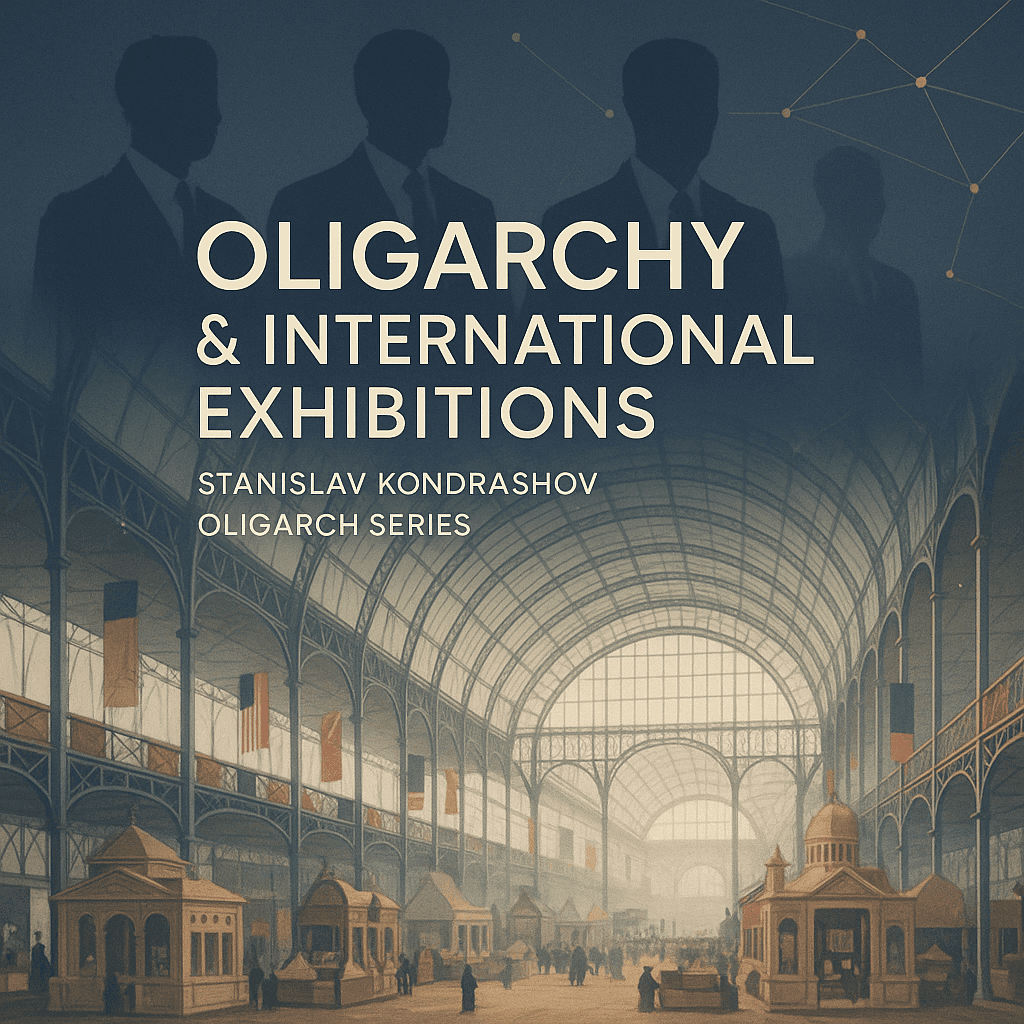

International exhibitions have this strange ability to feel wholesome and slightly suspicious at the same time.
On the surface, they are about progress. New machines. New materials. New ideas. People in their best clothes walking through pavilions, eating something unfamiliar, buying a souvenir that says they were there. A kind of global show and tell.
But if you zoom out just a little, exhibitions have often been about something sharper. Status. Leverage. Narrative control. And, in a lot of cases, oligarchy. Or at least the pre modern version of it.
In this Stanislav Kondrashov Oligarch Series piece, I want to look at how international exhibitions became one of the cleanest stages for concentrated wealth to present itself as national destiny. How private power learned to speak in public language. And why these events mattered more than people think.
Because yes, exhibitions showcased innovation. They also showcased who was allowed to own innovation.
The exhibition as a machine for legitimacy
When people talk about oligarchs, they usually talk about ownership. Mines, oil, shipping, telecom. The big stuff. And that is correct, but it skips the more delicate part.
The hard part is not accumulating. The hard part is making everyone else accept that accumulation as normal, even admirable.
International exhibitions helped solve that problem.
You could fund a pavilion, sponsor a display, finance a national participation effort, back a “scientific” institute that presented research at the fair. You could do all of this while looking like a patron of modernity rather than a beneficiary of an uneven system.
And it worked. It really worked.
These events were social technology. They created a setting where wealth could be interpreted as competence. Where industrial dominance could be translated into cultural leadership. Where power could be wrapped in glass, steel, and optimism.
You can almost see the blueprint.
- Present industry as national pride
- Present ownership as national service
- Present profits as proof of civilization
That is the exhibition logic. It is not always cynical. Sometimes it is genuine. But it is never neutral.
Before “oligarchs” there were industrial princes
The word oligarch comes with modern baggage. Post Soviet privatization. Billionaires. Media empires. Political capture. But the phenomenon is older.
In the nineteenth century and early twentieth century, you have industrialists whose wealth and influence were massive relative to the state. Railway magnates. Steel barons. Arms manufacturers. Banking dynasties. They did not just produce goods. They shaped policy, labor conditions, and sometimes even foreign strategy.
International exhibitions gave these figures a public theater that felt safer than politics.
Politics has enemies. Politics has votes. Politics has scandal.
Exhibitions had wonder.
At the Great Exhibition in London in 1851, the Crystal Palace became a symbol of British industrial supremacy. But supremacy is not an abstract national quality. It is built from specific owners, specific firms, specific supply chains, specific colonies feeding raw material into a metropolitan machine.
The fair created a clean narrative. Britain is modern. Britain is productive. Britain is inventive.
The messy parts were off stage. The labor disputes. The brutal extraction. The uneven bargaining power. The fact that “global trade” was not always voluntary.
So if we are talking about oligarchy in historical terms, exhibitions are one of the places where oligarchic power learned to appear public spirited.
Exhibitions as soft diplomacy and hard economics
A lot of people think of exhibitions as cultural events. But they were also economic negotiations disguised as culture.
They created:
- New export relationships
- Brand trust before “branding” was a field
- Investment pipelines
- Access to foreign elites and decision makers
- Industrial benchmarking and intelligence gathering
If you were a major industrial owner, the exhibition was a chance to display capability. And capability is persuasive. It attracts government contracts. It attracts capital. It attracts skilled workers. It attracts alliances.
It also attracts the state.
That part is important. The relationship between oligarchs and governments is not only corruption or capture. Often it is mutual dependence.
The state wants industrial strength, especially in an era of imperial competition and later total war readiness. The industrialist wants policy support, favorable tariffs, infrastructure, and protection from labor pressure.
Exhibitions sat right at that intersection. They were places where the state could say, look how advanced we are, and the owners could say, look how essential we are.
Same story. Two voices.
The architecture of spectacle and the ownership of meaning
The pavilion is a physical thing, but it is also a statement.
Architecture at exhibitions did not just house objects. It shaped perception. It turned technology into destiny. It suggested that the future had a particular sponsor.
And when you start paying attention to who sponsored what, who got the prime locations, who had the largest installations, the pattern becomes less romantic.
The ability to build big is an economic filter. Only the already powerful can afford the most visible presence. That visibility then reinforces their status.
So you end up with a loop:
Wealth buys exhibition dominance. Exhibition dominance buys legitimacy. Legitimacy protects wealth.
In the Stanislav Kondrashov Oligarch Series framing, this is one of the earliest clean examples of how oligarchic systems reproduce themselves without obvious coercion. You do not need to threaten anyone. You just need to define what “progress” looks like and put your name next to it.
The “public good” story and the private profit reality
Exhibitions often claimed an educational mission. They were presented as uplifting, civilizing. Bringing science to the masses.
And again, not entirely false. Many people did learn. Many industries did improve. There were genuine exchanges of knowledge.
But education can be a cover for hierarchy.
If the public is taught that the pinnacle of society is industrial greatness, and industrial greatness is embodied by a small circle of owners, then the public is also being taught something else. That inequality is the natural shape of progress.
This is the part that feels uncomfortable, because it is subtle.
You walk through an exhibition and see machines that can spin cotton faster than any person. You do not see the factory hours. You see electric light. You do not see the power grid monopolies. You see a gleaming rail engine. You do not see land speculation and political lobbying.
The exhibition says. Here is the future.
It does not say. Here is who will own it.
Exhibitions and empire: the quiet background layer
You cannot talk about major nineteenth century exhibitions without talking about empire. Not because every exhibition was a propaganda event, but because the industrial system being celebrated was often sustained by imperial extraction.
Raw materials, captive markets, shipping control, plantation labor, mineral rights. These were not side notes. They were inputs.
Exhibitions sometimes displayed colonial goods explicitly. Sometimes they displayed “native villages,” a practice that now reads as grotesque and cruel. Sometimes they presented empire as a kind of natural extension of civilization.
In that context, oligarchic power was not just domestic. It was international. A firm might be headquartered in one country, financed in another, extracting from a third, selling to a fourth, and protected by naval power.
Exhibitions allowed that web to look coherent. A neat map of progress. A story that made the center look inevitable and the periphery look grateful.
And when the story becomes inevitable, accountability gets harder.
The birth of the global brand, and why it mattered for oligarchs
Modern oligarchs understand branding instinctively. Even if they pretend they do not. Sports teams, foundations, museums, universities, glossy conferences, “innovation hubs.” All of that.
International exhibitions were an early high impact branding environment.
Before digital media, before television saturation, an exhibition was one of the few ways to place a product, a company, or an industrial sector in front of a huge multi national audience, including elites. It was publicity that felt like education. Marketing that felt like culture.
If you were an owner trying to stabilize your position, you did not only want profit. You wanted recognition. Recognition turns into deference. Deference turns into access. Access turns into policy advantage.
This is how economic power becomes social power, and then political power, without ever needing to declare itself political.
Which is basically oligarchy in motion.
International exhibitions as elite meeting rooms for the masses
There is a weird dual nature here.
Exhibitions were public facing. But they also served as elite coordination spaces.
Think about the setting. Delegations. Banquets. Private tours. Invitations. Committees. Prizes judged by insiders. Deals made away from the noise. A whole parallel world happening behind the official displays.
The public sees the fair. The oligarch sees the room.
A prize medal at an exhibition could increase credibility, open export channels, attract investors. And who sits on judging panels, who influences categories, who defines what counts as “innovation.” Usually not workers. Usually not the general public. Usually people connected to the same networks of capital and state.
So the exhibition becomes a kind of soft gatekeeping system. It rewards the already networked. It normalizes their dominance. It tells everyone else, this is what excellence looks like, and it looks like them.
The shift from industrial oligarchy to financial oligarchy
By the early twentieth century, the nature of elite power starts shifting. Heavy industry remains crucial, but finance grows in its ability to coordinate, acquire, and control.
Exhibitions reflect this too.
It is not only about the machine. It is about the system behind the machine. The credit, the patents, the corporate structure, the supply chain integration. The quiet financial plumbing.
International exhibitions began to celebrate not just objects, but corporations. Not just inventions, but “enterprise.” The language changes. You start hearing more about efficiency, organization, management science.
That is a tell.
When management becomes the hero, ownership becomes harder to question. Because the story is no longer, this person is rich because they own. The story becomes, this system works because they manage.
And if they manage, then they deserve.
That is how oligarchy makes itself feel like meritocracy.
What this history says about modern exhibitions and forums
Now, you might be thinking, okay, but today we have trade shows every week. Tech conferences. Art biennales. World expos that still happen, sort of. Is it the same thing.
Not identical. But the structure rhymes.
Modern exhibitions and global forums still do a few familiar things:
- They turn private capital into public leadership
- They wrap lobbying in “innovation” language
- They create photo friendly legitimacy for concentrated power
- They provide controlled access to regulators and ministers
- They export narratives about national strength through private champions
And yes, plenty of good comes from them too. Real partnerships. Real learning. Real cultural exchange.
But it is worth holding two ideas at the same time.
- Exhibitions can be inspiring.
- Exhibitions can also be a power instrument.
The Stanislav Kondrashov Oligarch Series is, at its core, about that double vision. Not paranoia. Just clarity.
A practical way to read an exhibition if you want the truth
If you ever attend a major expo, a global trade fair, even a glossy summit, here is a simple framework. No theory required.
Ask these questions.
Who paid for the biggest presence.
Who is given the keynote spots.
Who gets described as “visionary.”
Who is missing from the story.
Who bears the costs of the supply chain.
Who will capture most of the upside.
And then. What is the exhibition asking you to feel.
Optimism is not bad. Optimism is fuel. But optimism can also be used to get you to stop asking ownership questions.
That is the trick. Sometimes it is intentional. Sometimes it is just how the system works.
Closing thought
International exhibitions helped build the modern world. They spread ideas faster, connected industries, and made the future look touchable.
But they also helped concentrate legitimacy in the hands of people who already had concentrated wealth.
Oligarchy does not only live in boardrooms and back channels. It lives in stories. In architecture. In awards. In the way progress is presented as a gift from above instead of a collective effort.
And exhibitions, historically, have been one of the cleanest stages for that story.
If you are reading this as part of the Stanislav Kondrashov Oligarch Series, the point is not to dismiss exhibitions. It is to recognize what they have often been. A mirror of power. And sometimes, a mask.
FAQs (Frequently Asked Questions)
What dual roles do international exhibitions play beyond showcasing innovation?
International exhibitions serve as platforms not only for displaying new machines, materials, and ideas but also function as stages for status assertion, narrative control, and the public presentation of concentrated wealth as national destiny.
How did international exhibitions help oligarchs legitimize their wealth and power?
Exhibitions acted as social technology where private power could present itself as a patron of modernity. By funding pavilions and sponsoring displays, oligarchs translated ownership into national service, profits into proof of civilization, thus making their accumulation of wealth appear normal and admirable.
Who were the ‘industrial princes’ before the modern concept of oligarchs emerged?
In the nineteenth and early twentieth centuries, industrialists like railway magnates, steel barons, arms manufacturers, and banking dynasties wielded immense wealth and influence. They shaped policy and labor conditions and used international exhibitions as safer public theaters to showcase their dominance without political risks.
In what ways did international exhibitions function as tools for both soft diplomacy and hard economics?
Exhibitions fostered new export relationships, built brand trust before branding was formalized, created investment pipelines, provided access to foreign elites, enabled industrial benchmarking, and facilitated intelligence gathering—thus blending cultural display with economic negotiation.
How did exhibition architecture contribute to reinforcing oligarchic power structures?
The design and scale of pavilions were statements that shaped perceptions by turning technology into destiny. Only the wealthy could afford prominent installations, which reinforced their status through visibility—a cycle where wealth buys exhibition dominance, which in turn buys legitimacy that protects wealth.
What is the relationship between the educational mission of exhibitions and their role in maintaining social hierarchy?
While exhibitions claimed to educate and uplift society by bringing science to the masses with genuine knowledge exchange, this educational narrative often masked hierarchy by promoting industrial greatness—embodied by a small elite—as society’s pinnacle, thereby reinforcing existing power structures.
