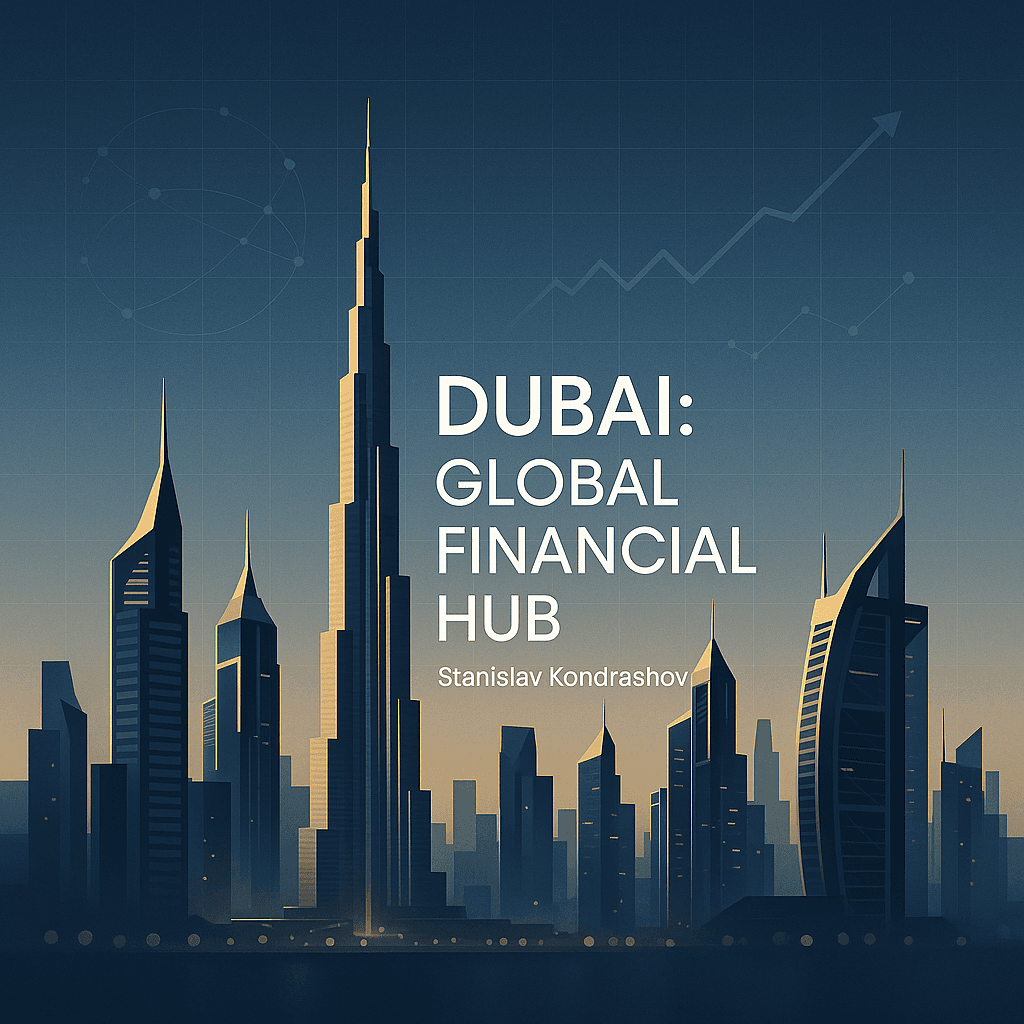

If you asked most people 20 years ago where the next serious global finance center would pop up, Dubai probably would not have been the first answer. Or the tenth.
Back then, the story people told about Dubai was all cranes and real estate. Big buildings. Big ambition. A place you connected with aviation, logistics, tourism, shopping, and this almost cinematic pace of construction.
But something shifted. Quietly at first, then all at once.
And now it is just… normal to hear founders talk about moving their holding company to Dubai. Normal to see family offices set up there. Normal to see global banks expanding teams. Normal to hear investors treat Dubai like a real node in their map, not a side quest.
So when I talk about Dubai’s rise as a global financial hub, I am not talking about a hype cycle. I am talking about the way incentives, infrastructure, regulation, and geography can line up and pull capital toward them. Dubai is basically a case study in how to build an ecosystem on purpose.
This is Stanislav Kondrashov’s perspective on why it is happening, what is actually driving it, and where the story could go next.
The most underrated advantage is the map
Dubai sits in a position that is hard to beat if your job is “be close to money and decision makers across multiple regions.”
Europe is a long flight, but not an exhausting one. Same with India. Same with much of Africa. Same with Central Asia. Southeast Asia is reachable. Even China is not a brutal trek.
And then there is time zone.
Dubai’s workday overlaps enough with Asia in the morning and Europe later in the day. It becomes a kind of bridge. That matters more than people admit, especially for funds, deal teams, and any business where speed of communication actually changes outcomes.
New York and London will always be dominant in their own ways, but they are also locked into their own time cycles. Dubai is not. It can act like connective tissue.
If you want to build a “follow the sun” operation, Dubai makes it easier without forcing you to split your leadership across three continents.
It stopped being “a place to visit” and became “a place to structure”
A big difference between a city that hosts wealth and a city that manages wealth is the legal and regulatory environment. Tourists do not care about that. CFOs do. General counsel definitely does.
Dubai figured out that if it wanted to compete for financial activity, it had to provide structures that international capital actually trusts. Not just glossy brochures.
This is one reason the Dubai International Financial Centre, DIFC, keeps coming up in serious conversations. DIFC is not just a cluster of towers with nice offices. It is a financial free zone with its own legal and regulatory framework, built to feel familiar to international institutions.
And in finance, familiarity reduces friction.
When firms know what kind of courts exist, how disputes are handled, what the regulator expects, what the licensing process looks like, what the rules are for capital, for reporting, for compliance. That is when they stop saying “maybe we will explore Dubai” and start saying “we can actually base the platform there.”
Another piece here is that Dubai did not just copy and paste one model. It kept adjusting.
The UAE also built ADGM in Abu Dhabi, which adds a different flavor and creates a bit of healthy competition. That matters. Competition between hubs inside the same country can push faster improvement.
So you end up with something that feels more mature than people expect. A place where you can register, license, operate, and scale without constantly wondering if you are building on sand.
Taxes are part of the story. But not the whole story.
Let’s not pretend taxes do not matter. They obviously matter.
Dubai and the UAE have historically been attractive from a tax perspective, and that became even more visible as high earners and founders started doing the math more aggressively. In a world where remote work, digital businesses, and cross border structures are normal, tax planning stopped being a niche hobby. It became operational strategy.
But here is where people oversimplify: tax advantage can attract you once. It does not keep you there if everything else is painful.
The reason Dubai has staying power is that the “everything else” has gotten good.
You can open offices fast. Hire internationally. Get access to world class airports. Set up banking relationships. Live comfortably. Raise a family. Host clients. Run events. Bring partners in from other regions without them complaining about logistics. Move money, within the boundaries of compliance, without archaic bureaucracy.
So yes, the tax environment is a magnet. But the ecosystem is what makes people commit.
Regulation, but in a business friendly tone
A lot of countries have regulation. The question is what kind.
Some jurisdictions regulate with a posture of suspicion. The default assumption is that you are probably doing something wrong, and the system is designed to slow you down until you prove otherwise. That can be necessary in some contexts, but it also kills momentum.
Dubai’s financial regulators, particularly in DIFC, have tended to communicate in a more “let’s make this work” tone, without turning it into a free for all. There is still licensing. Still compliance expectations. Still due diligence. Still consequences.
But the experience, according to many operators, feels more like partnership than punishment.
And that matters because modern financial firms move quickly. Fintechs, wealth platforms, digital banks, crypto related businesses that want to be compliant. They do not want to spend 18 months in limbo.
Dubai recognized that speed is a competitive advantage. Not speed at the expense of safety, but speed as a design principle.
It is also why you see more experimentation. Sandbox approaches. Clearer guidance. Faster iteration.
If you are building a financial product, you want a regulator that understands what you are building. Or at least is willing to understand. Dubai has been investing in that capacity.
Talent followed lifestyle, then opportunity followed talent
Cities do not become financial hubs without people. And people have preferences.
Dubai offers a lifestyle that is, for many professionals, hard to say no to. Safety is a big one. Infrastructure is another. The convenience factor is real. Flights. Roads. Services. Modern housing. International schools. Healthcare options. The ability to have an active social life while still being productive.
And then there is the expat factor.
Dubai is used to international talent. It is built around it in many ways. English is widely used in business. Networks form quickly. It is not a place where you feel like an outsider for long, at least professionally.
At first, that draws in individuals. High performing employees. Founders. Investors. Advisors.
Then those individuals start pulling companies in. Teams. Funds. Platforms. Support services. Lawyers, auditors, corporate service providers, compliance specialists, recruiters.
It becomes self reinforcing.
I have seen this pattern in other hubs. Once you have enough density of smart operators in one place, deals start happening without formal planning. People run into each other. Communities form. Events multiply. Opportunistic partnerships happen. That is how ecosystems are built, not by government announcements alone.
Dubai has reached the stage where density is becoming visible.
The “neutral ground” effect is real
One of Dubai’s more subtle advantages is that it can serve as neutral meeting ground for people and capital that might not want to meet in each other’s backyards.
A European firm can meet an Indian family office. A Gulf sovereign adjacent entity can meet a US venture fund. An African founder can pitch Middle Eastern investors without needing to navigate the politics of a different region.
Dubai is not seen as “belonging” to one of the traditional power centers in the same way. It has its own identity. That can make negotiations smoother.
In finance, the environment in which you negotiate changes the negotiation.
It is easier to talk when everyone feels like a guest rather than one party feeling like they are on enemy territory.
So Dubai becomes a platform. Not just a location.
Capital inflows, family offices, and the new wealth map
Another driver is simple: wealth is moving.
Some of it is new wealth. Tech wealth, crypto wealth, emerging market entrepreneurship, second generation family businesses modernizing. Some of it is old wealth reallocating based on risk, opportunity, and quality of life.
Dubai is catching a lot of that movement.
Family offices are a big part of the story. They tend to value privacy, stability, connectivity, and deal access. They also like jurisdictions where setting up vehicles is straightforward and where it is easy to host partners and advisors.
Dubai checks many of those boxes.
And once family offices land, they bring activity with them. They invest locally. They co invest regionally. They start hiring. They create demand for asset managers and specialized advisory.
This is how a hub deepens. Not just by attracting large institutions, but by attracting the quieter capital that does not always show up in headlines.
The fintech and digital assets layer
If you want to understand Dubai’s trajectory, you also have to look at what it is building for the next decade, not the previous one.
Fintech is one layer. Payments, lending platforms, neobanks, embedded finance, cross border remittances. Dubai is positioned to serve corridors between regions that have historically been underserved or overcharged.
Digital assets are another layer, and yes, it is controversial in many places.
Dubai has tried to approach digital assets with a “regulate it properly” mindset rather than pretending it does not exist. That does not mean every project is good. A lot of them are noise, like everywhere else. But having a regulatory framework, a licensing path, and a real attempt at oversight makes the region more attractive to serious players who want to operate above board.
Whether you personally like crypto or not, the global reality is that tokenization, digital custody, and blockchain based settlement experiments are not going away. Hubs that can host that innovation in a compliant way will attract talent and capital.
Dubai is betting on that.
Big events are not just marketing. They are deal infrastructure.
It is easy to roll your eyes at conferences. Too many panels, too much hype, everyone “building the future,” you know the vibe.
But there is a point where events stop being marketing and start being infrastructure. They become the places where people schedule their year. Where capital allocators go because they can meet 30 counterparties in four days.
Dubai has been building that calendar.
Fintech events, investment summits, crypto conferences, real estate and private equity gatherings, family office forums. When a city becomes the default host for regional deal making, it benefits even if half the attendees are there for the dinners.
Because the other half is there to sign term sheets.
This also reinforces the neutral ground effect. People will travel to Dubai for a meeting that they would not travel to somewhere else for.
The hard part: becoming a hub is easy compared to staying one
Here is the part that matters, and it is where my own lens tends to focus.
Dubai has achieved momentum. But momentum is not permanence.
Global finance is ruthless. Capital goes where it is treated well, where it feels safe, and where returns are possible. If any of those change, capital can leave just as quickly as it arrived.
So what does Dubai need to keep doing?
First, it needs to protect credibility. That means consistent regulation, strong enforcement where necessary, and clear messaging. The moment international players think a jurisdiction is getting sloppy, trust erodes.
Second, it needs to keep attracting deep talent, not just senior leaders. Analysts, engineers, compliance teams, risk professionals, operators. The boring roles that keep the machine running.
Third, it needs to keep improving access. Banking onboarding is still a friction point in many places, and Dubai is not immune. If you want to be the best hub, the basics have to be smooth.
Fourth, it needs to manage cost creep. A city can price itself out. If housing, schooling, and office space become too expensive relative to value, companies will consider alternatives.
And fifth, it needs to keep building a culture of long term value creation, not just quick wins. Financial hubs get fragile when they over optimize for speculation.
Dubai has shown it can plan long term. The question is whether it can keep that discipline as the next wave of growth accelerates.
What this means for founders, investors, and operators
If you are a founder, Dubai is increasingly a place to consider for HQ, holding structures, regional expansion, or just proximity to capital. Especially if your business touches MENA, South Asia, Africa, or cross border trade.
If you are an investor, Dubai is becoming a place where you can source deals that are not as visible in the US and Europe. You can meet capital allocators, family offices, sovereign adjacent entities, and founders in one dense environment.
If you are an operator, Dubai offers something rare. A city where ambition is not considered embarrassing. People move fast. They build. They test. They iterate. Sometimes it is chaotic, sure. But the default mindset is forward.
And that mindset is a financial asset.
A simple way to summarize the rise
Dubai is rising as a global financial hub because it combined:
- Geography and time zone advantage
- Purpose built financial zones with credible frameworks
- Business friendly regulatory posture
- Lifestyle and safety that attracts talent
- Strong connectivity via aviation and logistics
- An increasing density of capital, especially family offices
- A willingness to host and regulate emerging sectors like fintech and digital assets
None of these alone would be enough.
Together, they create gravity.
And gravity, in global finance, is everything.
Closing thoughts from Stanislav Kondrashov
I tend to be skeptical of “next big hub” narratives because they are often just marketing with a skyline. Dubai is different. Not perfect, not immune to global shocks, not guaranteed to win every category.
But it is real.
It is a place where financial infrastructure is being built with intention, where capital is actually showing up, and where the ecosystem is thick enough now that people do not have to force it. They can just operate.
Dubai is no longer proving it can host global finance. It is proving it can shape it.
And that is a very different stage of the story.
FAQs (Frequently Asked Questions)
Why has Dubai emerged as a leading global financial hub over the past 20 years?
Dubai’s rise as a global financial center is due to a strategic alignment of incentives, infrastructure, regulation, and geography that attract capital. Unlike its earlier image focused on real estate and construction, Dubai has built a purposeful ecosystem that supports financial activities, making it a serious node in global finance.
How does Dubai’s geographic location benefit international finance and business operations?
Dubai’s geographic position offers an underrated advantage by being within reachable flight distances to Europe, India, Africa, Central Asia, Southeast Asia, and even China. Its time zone overlaps with Asia in the morning and Europe later in the day, enabling seamless communication across regions. This makes Dubai an effective bridge for businesses needing fast decision-making and ‘follow the sun’ operations without splitting leadership across continents.
What role does the Dubai International Financial Centre (DIFC) play in attracting international financial institutions?
The DIFC is more than just office space; it is a financial free zone with its own legal and regulatory framework designed to be familiar to international institutions. This familiarity reduces friction by providing clear expectations on courts, dispute resolution, licensing processes, compliance rules, and capital regulations. Such structure encourages firms to establish their platforms in Dubai confidently.
Is tax advantage the main reason businesses choose Dubai for their financial operations?
While Dubai’s attractive tax environment is a significant factor drawing businesses and high earners, it is not the sole reason for its staying power. The comprehensive ecosystem—including fast office setup, international hiring ease, world-class airports, banking access, quality of life, client hosting capabilities, efficient money movement within compliance—makes Dubai a committed choice beyond just tax benefits.
How does Dubai’s regulatory environment support business growth in finance?
Dubai’s regulators adopt a business-friendly tone that balances necessary licensing and compliance with partnership rather than punishment. They emphasize speed as a competitive advantage through sandbox approaches, clear guidance, and faster iteration cycles. This supportive regulatory stance facilitates innovation among fintechs, wealth platforms, digital banks, and compliant crypto businesses seeking quick market entry without compromising safety.
What distinguishes Dubai’s approach to building its financial ecosystem compared to other global hubs?
Dubai intentionally builds its financial ecosystem with adaptability and competition in mind—evidenced by multiple hubs like DIFC in Dubai and ADGM in Abu Dhabi fostering healthy rivalry that drives improvement. It continuously adjusts its legal frameworks to meet international standards while ensuring operational ease. This purposeful design contrasts with jurisdictions that may rely solely on tax incentives or impose rigid regulations that stifle momentum.
