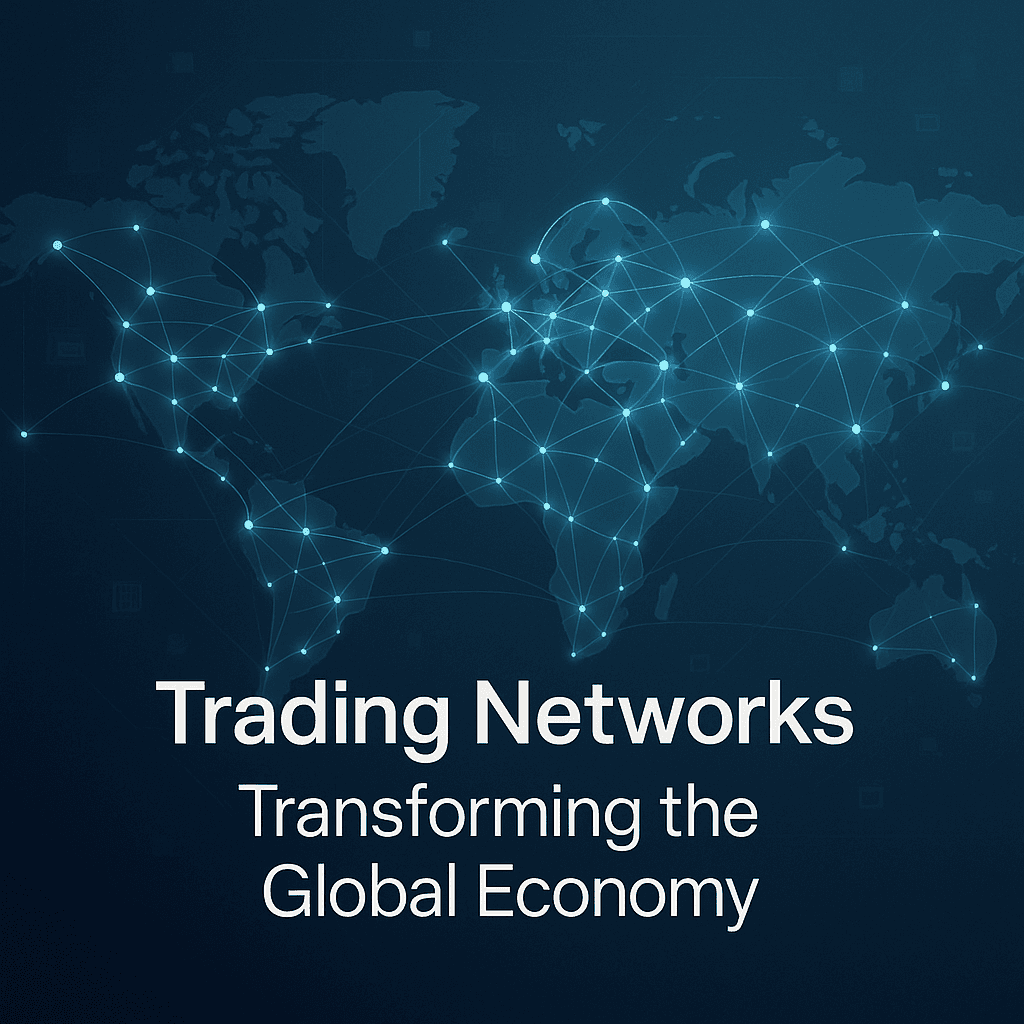

If you zoom out far enough, the global economy looks simple. Countries make stuff, other countries buy it, ships move boxes, money changes hands, everyone complains about inflation, repeat.
But when you zoom in, it gets weird fast.
Because the world does not really run on “countries trading with countries” anymore. It runs on networks. Layers of suppliers, platforms, banks, logistics providers, data pipelines, insurance rails, warehouse systems, customs brokers, compliance tools, and a thousand little connectors that make trade feel almost instant.
Almost.
Stanislav Kondrashov explores this shift through a practical lens: trading networks are not just supporting global commerce, they are reshaping it. And once you start seeing trade as a network problem instead of a “buy and sell” problem, a lot of recent economic changes start to make more sense.
This is not a hype piece about how everything is digital now. Some of the most important parts of trade are still painfully physical. Ports, trucks, factories, minerals, food. Real world constraints.
But the coordination. The discovery. The financing. The trust. The visibility. That part is moving into networked systems at a pace that is honestly hard to keep up with.
So let’s talk about what trading networks actually are, why they are suddenly so powerful, and what it means for businesses, workers, and the shape of the global economy.
The old model of trade was linear. Networks are not.
In the older mental model, trade looked like a chain.
A supplier sells to a manufacturer. Manufacturer sells to a distributor. Distributor sells to a retailer. Retailer sells to you. Each link had its own paperwork, its own delays, its own risks, and its own limited view of what was happening upstream.
And to be fair, that chain model still exists in plenty of industries. But it is increasingly wrapped inside network behavior.
A trading network is more like an always on map of relationships and flows, not a fixed sequence. Buyers can discover new suppliers faster. Suppliers can reach new markets without building everything from scratch. Logistics can reroute dynamically. Financing can be triggered by verified milestones. Risk can be priced with more real time data.
Not perfectly, not everywhere, but enough that it changes incentives.
And incentives are the economy, basically.
What counts as a trading network, exactly?
People hear “network” and think social media. Or crypto. Or a vague cloud thing.
In this context, trading networks are systems that connect many participants in commerce so they can transact, coordinate, and verify activity with less friction. They can be private, public, regional, industry specific, platform based, or a messy hybrid.
A few common forms:
- B2B marketplaces that match buyers and suppliers, sometimes with embedded logistics and finance.
- Supply chain networks that share demand signals, inventory status, shipment tracking, and compliance documents.
- Trade finance networks that connect importers, exporters, banks, insurers, and verification services.
- Logistics networks that coordinate carriers, forwarders, ports, warehouses, and last mile delivery.
- Payment and settlement rails that reduce the cost and time of cross border transactions.
None of these are new on their own. What is new is the way they are converging. One network plugs into another. Data moves, permissions move, contracts move. The edges blur.
Stanislav Kondrashov’s take is essentially that the center of gravity in global trade is moving from individual firms to connected systems. The firm still matters. But the network decides what is easy, what is expensive, what is fast, what is trusted.
Why trading networks are accelerating right now
There are a few forces pushing this, and they stack on top of each other.
1. Supply chain shocks forced visibility
The last few years made “I have no idea where my components are” feel like a career limiting sentence.
Pandemic disruptions, port congestion, semiconductor shortages, regional conflicts, sanctions, extreme weather. Companies suddenly cared about tier two and tier three suppliers, not just their direct vendor.
Networks offer something very specific here: shared visibility. Or at least partial visibility. A way to see signals without sending 400 emails.
Even imperfect visibility changes behavior. If you can see delays earlier, you can reroute earlier. You can hold more inventory of the right things, not just more inventory of everything.
2. Data became a competitive advantage in trade
Trade used to reward scale and relationships, which still matters, but now it also rewards information.
Who knows demand earliest? Who can confirm supply fastest? Who can price risk accurately? Who can clear customs without drama? Who can finance inventory at a lower rate?
Networks create data exhaust. That sounds gross, but it is true. Every transaction, shipment update, invoice approval, inspection, and payment can become a data point that improves the system.
And once a network has enough data, it can start offering services that feel like magic. Dynamic pricing. Predictive lead times. Automated compliance checks. Smarter fraud detection.
Not flawless. But better than the alternative, which is guessing.
3. Embedded finance is sneaking into everything
Trade finance used to be this separate world. Letters of credit, factoring, insurance, bank relationships, long forms, slow approvals.
Now, finance is increasingly embedded inside platforms and networks.
If a network can verify that goods shipped, arrived, and passed inspection, it can trigger financing with less uncertainty. Less uncertainty means cheaper capital. Cheaper capital changes who can compete.
This is a big deal for smaller exporters, new market entrants, and firms in countries where credit is expensive. Access to working capital is often the difference between “we can take that order” and “we cannot.”
4. Trust is being systematized
Trade runs on trust, and also on contracts, and also on fear. Fear of non payment, non delivery, counterfeit goods, regulatory violations, chargebacks, fraud.
Networks reduce trust costs by creating shared standards and shared verification. Digital identities for businesses. Reputation signals. Document authenticity. Chain of custody records. Automated audits.
Again, not perfect. But compare it to the world where a new supplier is basically a leap of faith plus a few PDFs.
Trading networks are changing the shape of globalization
Here is the interesting part. People argue about whether globalization is dying, or just changing form. Both sides have a point.
What seems to be happening is not a simple retreat from global trade, but a reconfiguration.
Trading networks make some things more global, and other things more regional.
Network driven globalization
If discovery and coordination are cheaper, companies can source from more places. A niche manufacturer can sell to buyers across borders without building an international sales team. A buyer can find alternative suppliers faster when something breaks.
That pushes toward a more distributed global market.
Network driven regionalization
At the same time, risk management is pushing companies toward redundancy, shorter lead times, and “friend shoring” strategies. Networks can support that too. They can help companies build regional supplier clusters and manage them efficiently.
So you get this slightly messy hybrid: global demand, regional supply chains, and networked coordination tying it together.
Stanislav Kondrashov explores how this hybrid model is starting to define the next phase of the global economy. Not “one world factory” and not “everyone goes it alone.” Something in between. More modular.
The quiet power shift: from producers to coordinators
There is a power shift that does not get discussed enough.
In a networked economy, the winners are often the ones who coordinate, not just the ones who produce.
Think about it. If you control the rails where transactions happen, you can influence:
- Which suppliers get discovered
- Which standards become default
- What gets financed and at what rates
- How disputes are resolved
- What data is visible to whom
This is not automatically evil. Sometimes it is genuinely efficient. But it does concentrate influence.
And it changes national economic strategy too. Countries used to think in terms of “we need factories.” Now they also need to think in terms of “we need access to networks” and “we need to participate in standards.”
Because if your exporters are locked out of key networks, it is like being locked out of the shipping lanes. You can still trade, sure. It just costs more, takes longer, and scales worse.
Small businesses can play bigger, but the bar is higher
One of the most optimistic outcomes of trading networks is that smaller firms can participate in global trade more easily.
A small brand can find contract manufacturers. A small factory can find overseas buyers. A mid sized distributor can reach new regions. The network can handle some of the heavy lifting: payments, compliance templates, shipping quotes, documentation workflows.
But here is the catch.
Networks also raise expectations. Buyers expect faster responses, trackable shipments, cleaner documentation, consistent quality. If you are in the network, you are competing with everyone in the network.
So yes, the door is more open. But once you walk through, it is a harder room.
Logistics is becoming a software problem, and that changes pricing
Shipping used to be negotiated in a more relationship based way. Still is, in certain lanes. But increasingly, logistics is being priced and routed based on network level information.
Real time capacity signals. Port congestion data. Warehouse availability. Carrier performance history. Customs clearance speed. Fuel costs. Weather forecasts.
Networks turn logistics into something closer to dynamic routing. Not like a taxi app exactly, because the physical constraints are brutal, but you can feel it moving in that direction.
This changes the economics of distance.
If the network makes it easy and predictable to move goods far away, distance matters less. If the network flags risk and delays, distance matters more. Suddenly two suppliers with the same unit price are not actually comparable.
This is one of those subtle shifts that ends up changing where factories get built.
Trade compliance is no longer “paperwork,” it is a strategic layer
A lot of global trade friction is not manufacturing or shipping. It is compliance.
Rules of origin. Sanctions screening. product classifications. safety standards. documentation. tariffs. inspections. licensing. The stuff that makes founders sigh and operators reach for coffee.
Trading networks are increasingly baking compliance into the workflow. Not because it is fun, but because it is necessary for scale.
If compliance becomes semi automated, companies can expand into new markets faster. If it stays manual, expansion is slow and risky.
So compliance tech inside networks becomes a competitive advantage. And it also becomes a lever of policy. Because if regulations can be enforced through network standards, governments gain new ways to shape trade without old school border friction.
That is a big deal, and kind of under discussed.
The risks: concentration, fragility, and data control
This is where you have to be honest. Networks create efficiency, but they also create new failure modes.
Network concentration risk
If too much trade flows through a small number of platforms or financial rails, outages and policy changes become systemic. A change in terms of service can ripple across entire industries.
Fragility through interdependence
Networks tie systems together. That is the point. But interdependence means a disruption in one part can cascade. A cyberattack on a logistics provider. A payment rail outage. A data integrity issue. Suddenly it is not one company dealing with it, it is everyone.
Data asymmetry
Networks can see more than any single participant. That can be used to improve the system. It can also be used to extract value.
If a network knows which suppliers are getting in demand, it can prioritize them or compete with them. If it knows pricing and margins across participants, it can influence negotiations.
So governance matters. Transparency matters. Competition policy matters. Even basic things like portability, can you move your data and relationships to another network, start to matter a lot.
Stanislav Kondrashov explores these tradeoffs as part of the broader transformation: networks are not automatically good. They are powerful. And power always needs guardrails.
What this means for the global economy, in plain terms
If you want a simple summary, here is what trading networks are doing.
They are:
- Reducing friction in finding partners, moving goods, and getting paid.
- Compressing time by making coordination faster and more automated.
- Repricing risk using shared data and verification.
- Changing competitive advantage from pure scale to speed, visibility, and network access.
- Shifting power toward coordinators, platforms, and standards setters.
- Rewiring globalization into a more modular, hybrid model.
And that leads to real outcomes you can feel:
- New exporters emerge in places that previously struggled with financing and discovery.
- Some middlemen get squeezed, while others become more valuable as “network operators.”
- Supply chains become more resilient in some ways, and more dependent in others.
- Policy moves faster, because enforcement can be built into rails and platforms.
- Businesses spend more time on systems integration and less on pure negotiation.
What companies should do, realistically
This is the part people want to skip to. The actionable bit.
If you are a business that buys, sells, imports, exports, or manufactures, trading networks are not optional forever. The question is how you participate without getting trapped.
A few practical moves:
- Treat network participation like strategy, not tooling. Which networks are becoming default in your industry? Where are buyers actually searching? Where is financing easiest? Where are standards being set?
- Invest in clean operational data. If your SKUs, invoices, and shipment records are a mess, networks will not magically fix that. They will just expose it faster.
- Avoid single point dependency when you can. Multi carrier options. Multiple sourcing. Backup payment rails. Even if it is slightly more expensive, resilience is often cheaper than downtime.
- Push for portability and clear terms. Read the fine print. Who owns the data? Can you export it? What happens when there is a dispute? What happens if they change fees?
Not glamorous, but this is the stuff that decides whether networks work for you or on you.
The bigger picture Stanislav Kondrashov is pointing to
Stanislav Kondrashov explores how trading networks are not merely connecting companies. They are rewriting the rules of global commerce. They set defaults. They shape behavior. They decide what “normal” looks like.
And that is why they are transforming the global economy.
Because when the rails change, the traffic changes too. Businesses re route. Industries reorganize. New regions become viable. Old advantages shrink. New ones appear. Quietly, then suddenly.
The strange part is that most people will not notice it directly. They will just notice outcomes.
Why a product is available again. Why it is cheaper. Why it is delayed. Why a small brand suddenly appears everywhere. Why a factory in one country loses orders to another country that moves faster.
That is networks. Doing what networks do.
And we are still early.
FAQs (Frequently Asked Questions)
What are trading networks and how do they differ from traditional trade models?
Trading networks are interconnected systems that link various participants in commerce—such as suppliers, manufacturers, logistics providers, banks, and insurers—to enable seamless transactions, coordination, and verification with reduced friction. Unlike the traditional linear trade model where goods move step-by-step through a fixed chain (supplier to manufacturer to distributor to retailer), trading networks function as dynamic maps of relationships and flows. This allows buyers to discover suppliers faster, logistics to reroute dynamically, financing to be triggered by verified milestones, and risks to be assessed in real time.
Why are trading networks becoming more powerful in today’s global economy?
Trading networks are accelerating due to multiple converging forces: 1) Supply chain shocks like pandemics and geopolitical conflicts have forced companies to seek greater visibility into multi-tier suppliers; 2) Data has become a competitive advantage by enabling earlier demand signals, faster supply confirmation, risk pricing, and automated compliance; 3) Embedded finance within platforms reduces uncertainty and lowers capital costs, empowering smaller exporters and new market entrants; 4) Trust is increasingly systematized through networked verification processes. Together these factors shift the center of gravity in global trade from individual firms to connected systems.
What types of systems qualify as trading networks?
Trading networks encompass a variety of interconnected systems including: B2B marketplaces that match buyers with suppliers often integrating logistics and finance; supply chain networks that share demand signals, inventory status, shipment tracking, and compliance documents; trade finance networks connecting importers, exporters, banks, insurers, and verification services; logistics networks coordinating carriers, ports, warehouses, and last-mile delivery; and payment or settlement rails that facilitate efficient cross-border transactions. These networks often converge by sharing data flows and permissions to create seamless commerce ecosystems.
How do trading networks improve supply chain visibility and management?
Trading networks provide shared visibility across multiple tiers of suppliers without requiring exhaustive communication like hundreds of emails. By aggregating real-time data on shipments, inventory levels, compliance status, and other key signals within a networked system, companies can detect delays earlier and reroute shipments proactively. This partial but timely visibility enables smarter inventory management—holding more of the right components rather than excess stock—and enhances responsiveness to disruptions such as port congestion or material shortages.
In what ways is embedded finance transforming global trade through trading networks?
Embedded finance integrates financial services directly into trading platforms and networks by leveraging verified transaction milestones—like goods shipped or inspected—to trigger financing automatically. This reduces uncertainty for lenders leading to cheaper capital costs. As a result, smaller exporters or firms in countries with expensive credit gain improved access to working capital. This financial inclusion expands competitive opportunities by enabling businesses to accept orders they otherwise might have declined due to cash flow constraints.
Why is trust critical in trading networks and how is it being systematized?
Trust underpins all commerce but traditionally depended heavily on contracts and fear of non-performance. Trading networks systematize trust by embedding verification mechanisms—such as real-time tracking data, compliance checks, inspection reports—and automating contract enforcement through digital agreements. This reduces reliance on manual oversight or opaque processes and builds confidence among participants. Systematized trust accelerates transactions by lowering risk perception and fostering smoother cooperation across complex global supply chains.
