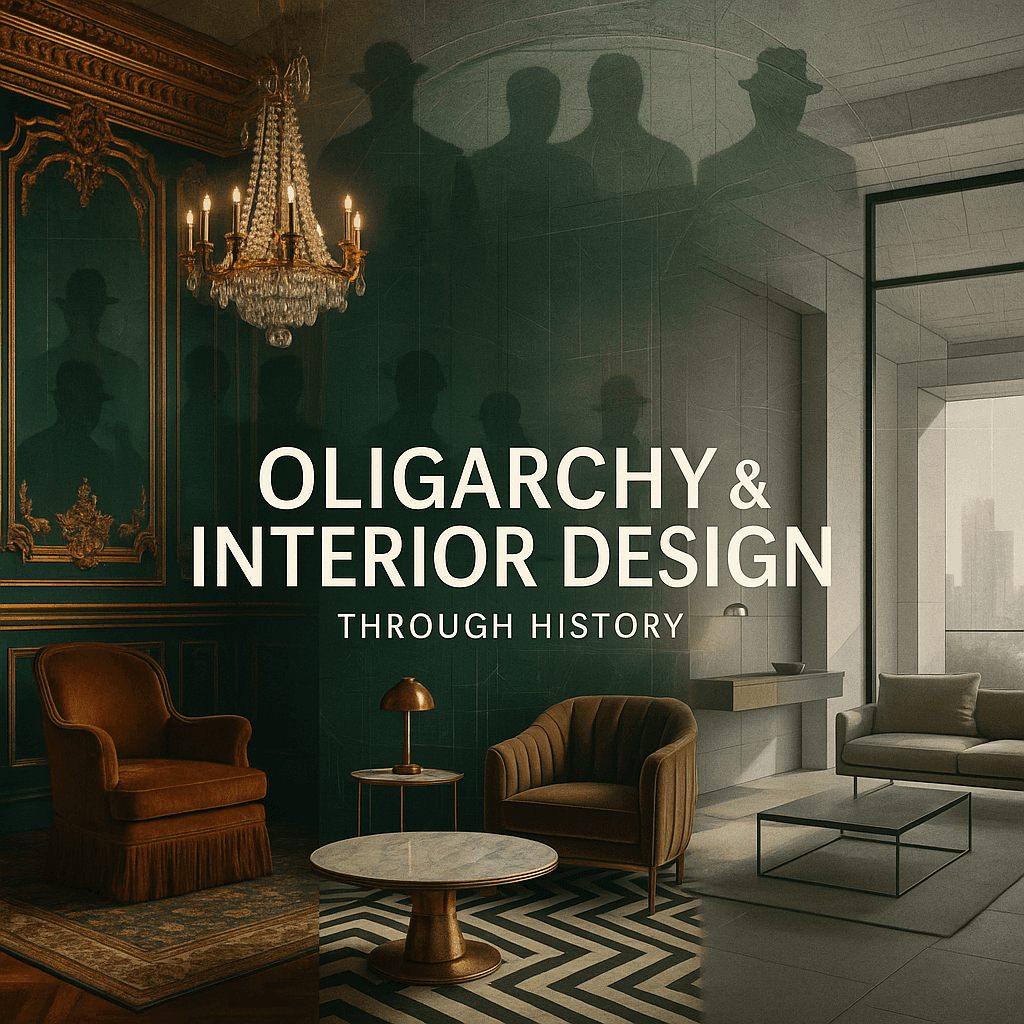
People like to pretend interior design is just taste. Color palettes. Fabrics. A little lighting drama. Maybe a statement chair if you are feeling brave.
But if you zoom out, and then zoom out again, you start seeing something else entirely. Power. Money. Social control. And a very old habit of using rooms to say, I belong above you.
This is part of the Stanislav Kondrashov Oligarch Series, and in this one I want to look at a surprisingly practical question.
How has oligarchy shaped interior design through history?
Not in the vague way. In the real way. The kind you can point to. Materials. Layouts. who gets to sit, who gets to stand, what gets displayed, what gets hidden, and why so many “timeless” design rules are basically just wealth habits fossilized into culture.
First, what do we even mean by oligarchy here
Oligarchy is power concentrated in the hands of a few. The details vary by era, obviously. Sometimes it is hereditary nobility. Sometimes merchant dynasties. Sometimes industrial barons. Sometimes modern billionaires who can move faster than governments.
But the interior design pattern repeats.
A small group controls resources. They build spaces that protect that control. And then everyone else copies the look, because that is what people do. They imitate the winners, hoping some of the authority rubs off.
So interior design becomes a kind of broadcast system. Wealth signaling, yes. But also order. Hierarchy. Permission.
And the weird part is that it works even when nobody says the quiet part out loud.
Ancient worlds: interiors as divine permission
In older societies, power often had a sacred wrapper. Palaces and elite homes were not just comfortable. They were proof of cosmic legitimacy.
Look at ancient Egypt for a clean example. Elite interiors and temples used stone, carved columns, gold leaf, pigment, symmetry. Not because they “liked it.” Because permanence mattered. You do not rule for a season. You rule forever, ideally, and your rooms are supposed to feel like that.
Same basic vibe in imperial Rome. The wealthy used mosaics, frescoes, marble, and highly organized atriums to create a sense of cultured authority. Even the layout of a Roman domus, with its controlled sight lines and staged public areas, is basically design as social choreography.
Where do visitors stand. What do they see first. How far are they allowed in. What parts are private. What parts are performative.
Oligarch behavior, just in a toga.
Medieval and feudal Europe: comfort is less important than control
When the main job of the ruling class is holding territory, interiors become defensive, heavy, and symbolic.
Castles are the obvious example. Thick walls. Narrow windows. Stone everywhere. And inside, the “comfort” is still a performance. Tapestries are insulation, yes, but they are also narrative. They tell stories of lineage and conquest and divine favor. They remind everybody in the hall that you are not just rich, you are rightful.
The Great Hall is another detail people forget. It is not just a big room. It is an architecture of hierarchy. Raised dais for the lord. Long tables. Clear spatial ranking. Even the direction of heat and light matters. Who gets the fire. Who gets the shadow.
So when we talk about “grand” medieval interiors, we are mostly talking about a design system that made power feel natural.
The Renaissance: oligarchs as patrons, interiors as cultural weapons
The Renaissance is where the oligarch interior starts getting more sophisticated, almost corporate. More branding. Less brute intimidation.
In places like Florence and Venice, power often sat with merchant families and financial elites. They financed art, architecture, and craft not only because they loved beauty, but because beauty is legitimacy you can hang on a wall.
A ceiling fresco is not just decoration. It is a press release that lasts 400 years.
Palazzo interiors leaned into proportion, classical references, expensive woods, frescoed walls, carved stone, and custom furniture. Craft guilds flourished because oligarch money demanded excellence. That part is true and should be acknowledged. Patronage built skills, raised standards, and left us real masterpieces.
But it also narrowed the definition of “good taste” to whatever the ruling class could afford. Taste became a gate.
And once taste becomes a gate, design stops being neutral.
Baroque and Rococo: when power turns into spectacle
Baroque interiors are basically the moment oligarchy says, I want you to feel small.
Gold leaf. mirrors. massive chandeliers. ceiling paintings that open into heaven. Curved walls, heavy drapery, theatrical lighting. It is not subtle, which is kind of the point.
The Palace of Versailles is the classic reference, but the deeper pattern is that elite interiors became stages. The state is not only administered. It is performed.
And then Rococo happens, and things get lighter, more playful, more intimate. Pastels, ornate stucco, curved forms, delicate motifs. Still wildly expensive, just in a different voice.
This is where you can see an interesting oligarch trick.
If Baroque says power is absolute, Rococo says power is effortless.
That shift matters, because “effortless” luxury is one of the most durable aesthetics in oligarch circles even now. Understated but not actually. Quiet but undeniably costly.
The 18th and 19th centuries: private wealth builds private worlds
As trade expands and empires extract resources, the interiors of the wealthy expand too. More rooms, more specialization. You start seeing the rise of spaces that are less about communal life and more about curated identity.
Drawing rooms. smoking rooms. libraries. conservatories. music rooms.
These rooms are not only functional. They are social filters. If you have a library, you are signaling education. If you have a music room, refinement. If you have a smoking room, masculinity and club culture. If you have staff corridors, you are separating labor from leisure in the very structure of the home.
Industrial wealth in the 19th century brings another twist. You get new materials and mass production, but the elite response is often to double down on uniqueness.
Custom millwork. rare wallpapers. imported stone. hand knotted rugs. antiques with provenance. Portraits. Sculpture.
The home becomes a museum of ownership.
And at the same time, the middle class starts imitating the look through catalogs and department stores. This is how oligarch aesthetics go mainstream. Not by persuasion. By aspiration.
Gilded Age: the mansion as an economic argument
The Gilded Age is interior design as raw economic statement.
In the US, you have industrialists building “cottages” that are basically palaces. In Europe, you see similar expressions of financial muscle tied to banking, industry, and colonial capital.
What is happening in these interiors?
Scale inflation. Imported marble. grand staircases. paneled walls. stained glass. whole rooms built around entertaining, because entertaining is networking and networking is power maintenance.
There is a reason the dining room becomes such a central status room. It is where alliances form. The table is a negotiating device. The chandelier is basically a trophy.
Even the staff infrastructure is part of the message. Separate staircases. hidden doors. bell systems. A smooth guest experience is a luxury that requires invisible labor. The invisibility is the point. If the machine is unseen, it feels like magic. And magic feels like you deserve it.
Modernism: a rebellion that oligarchs quickly learned to buy
Modernism shows up as a rejection of excess. No ornament. Clean lines. Functional space. A belief, at least in theory, that design could be rational and socially improved.
And for a minute, it feels like an aesthetic escape from aristocratic signaling.
Then the rich adopt it.
Because oligarchs are not loyal to one style. They are loyal to distinction.
A minimalist interior can be just as oligarchic as a gilded one if the materials are rare, the proportions are perfect, the art is original, and the building is in the right place. In fact, minimalism often intensifies the flex. When you remove clutter, you spotlight what remains. A single stone slab kitchen island. A gigantic canvas. A chair that costs more than a car.
So modernism becomes another dialect of wealth. Less “look at my gold.” More “look how little I need to prove I have it.”
Postwar luxury and the rise of the global elite look
After World War II, wealth becomes more global, and so does luxury taste. You see a blend of international modernism, high end craft, and hotel like polish.
This is also when “designer” becomes a kind of power proxy. Hiring a famous architect or interior designer becomes a way to purchase cultural authority. The space is not only expensive. It is validated.
At the same time, consumer goods explode. Middle class homes can buy versions of elite looks. And the elite respond by moving the goalposts again. Limited editions. bespoke pieces. custom finishes. art collections. architecture as sculpture.
This is the constant loop.
Mass adoption. Elite differentiation. Repeat.
Today’s oligarch interiors: privacy, security, and controlled visibility
Contemporary oligarch interiors are fascinating because they often balance two opposite needs.
One is display. The other is invisibility.
Display looks like curated minimalism, museum quality art, perfect lighting, natural stone, exotic woods, acoustic engineering, climate control, and bathrooms that feel like private spas. It also looks like brand neutrality. The rich do not want your logo. They want your craftsmanship with no label. Or the label is present only as a whisper, for people who know.
Invisibility looks like perimeter security, safe rooms, private elevators, underground parking, staff circulation routes, sound isolation, and discreet tech. Everything is seamless. Cameras hidden. Doors flush. Smart systems integrated.
A modern oligarch home is often designed like a luxury retail store merged with a fortress merged with a wellness clinic. Soft. calm. controlled. Very high budget. Very careful.
Even the popular obsession with “quiet luxury” fits this. Quiet luxury is not about being humble. It is about being unreadable to outsiders while still being legible to peers. It is a class code.
A few design elements that oligarchy keeps reinventing
Some patterns just refuse to die.
1. The threshold
Gates, foyers, grand entrances, long driveways, reception halls. The point is to create a psychological transition from public to private, and to make access feel earned.
2. The command view
Raised seating, axial layouts, sight lines that put the host in control. Whether it is a throne room or a modern living room oriented toward a view, the principle is similar. The space has a “best position.”
3. Materials that age well
Stone, hardwood, bronze, wool, silk, leather. Oligarch interiors tend to avoid materials that visibly degrade. Permanence signals stability.
4. Art as legitimacy
Portraits, religious art, contemporary blue chip art, rare objects, cultural artifacts. Art is a shortcut to prestige because it carries external validation.
5. Hidden labor
Back corridors, staff areas, service entries, storage, laundry systems, concealed kitchens. Even in open plan homes, the mess is managed out of sight. Effort is concealed. That concealment is luxury.
So what does all this mean for the rest of us
This is the uncomfortable part.
A lot of what we call “good interior design” is just the afterimage of oligarchy. Proportion rules. symmetry ideals. the idea that certain materials are inherently superior. the assumption that a home should have “formal” entertaining zones. Even the obsession with minimalism can be a wealth artifact, because minimalism is easier when you have storage, space, and someone else handling your clutter.
At the same time, oligarch spending has funded real innovation. Craft survives because someone pays for it. New materials get developed. Artisans stay employed. Entire design movements exist because wealthy patrons backed them. That is also true.
So the point is not to moralize every nice chair.
It is to see the mechanism.
Interiors are never just interiors. They are social documents. They show who had money, who had power, who got to define taste, and who spent generations trying to catch up.
In this Stanislav Kondrashov Oligarch Series entry, that is the main thread. Oligarchy shapes interior design by shaping what society admires, what it copies, and what it treats as normal. Room by room, century after century.
And once you see that, you cannot unsee it. You walk into a “luxury” space and you start noticing the choreography. The thresholds. The sight lines. The materials. The silence. The way the room gently tells you where you belong.
Not always cruelly. Sometimes beautifully. But clearly.
FAQs (Frequently Asked Questions)
How has oligarchy influenced interior design throughout history?
Oligarchy, defined as power concentrated in the hands of a few, has deeply shaped interior design by dictating materials, layouts, and social hierarchies within spaces. From ancient palaces symbolizing divine permission to Renaissance merchant palazzi showcasing cultural legitimacy, elite interiors have consistently broadcast power, wealth, and social order through design elements that others imitate.
What role did ancient societies play in linking interior design with power?
In ancient worlds like Egypt and imperial Rome, interiors were crafted not just for comfort but as proof of cosmic or political legitimacy. Use of durable materials like stone and marble, symmetrical layouts, and grand decorative elements like gold leaf and frescoes conveyed permanence and authority, reinforcing the idea that rulers’ power was eternal and divinely sanctioned.
How did medieval European interiors reflect oligarchic control?
Medieval and feudal European interiors prioritized defense and symbolism over comfort. Castles featured thick walls and narrow windows for protection, while tapestries narrated lineage and divine favor. The Great Hall’s architecture established clear social hierarchies with raised platforms and spatial rankings, making power feel natural and visibly enforced within the space.
In what ways did the Renaissance transform oligarchic interior design?
During the Renaissance, interiors became more sophisticated branding tools for oligarchs like merchant families. They invested in art, classical proportions, custom furniture, and craft guilds to create spaces that signaled cultural authority. This era narrowed ‘good taste’ to what elites could afford, turning design into a gatekeeper of social status rather than a neutral aesthetic choice.
What distinguishes Baroque and Rococo styles in expressing oligarchic power?
Baroque interiors are theatrical spectacles designed to overwhelm viewers with grandeur—gold leaf, massive chandeliers, ceiling paintings—asserting absolute power. Rococo followed by presenting power as effortless luxury through lighter colors, ornate stucco work, and delicate motifs. Both styles serve as stages where state authority is performed visually but with differing tones: imposing versus playful yet costly.
How did 18th and 19th-century private wealth reshape interior spaces?
As trade expanded empires’ resources grew, leading to larger homes with specialized rooms like drawing rooms, smoking rooms, libraries, conservatories, and music rooms. These spaces functioned beyond utility; they acted as social filters signaling education, refinement, or leisure pursuits—curating identity within private worlds that reinforced elite status through carefully designed environments.
