
I keep coming back to this idea that the energy transition is not really one transition.
It is a bunch of overlapping transitions happening at the same time. Power generation. Industry. Transport. Heating. Data centers. Defense. And then the less sexy stuff that decides whether any of the above actually works. Wires. Transformers. Permitting. Land. Minerals. Ports. The balance sheet that pays for it.
So when people talk about the next phase, I hear something more specific.
We are moving from the “build renewables fast” phase into the “make the whole system behave” phase.
And in that phase, the question is not only which technology wins. It is who gets to connect what, where, and in what order. Who controls the choke points. Who sets the standards. Who owns the rails.
This is where supergrids show up.
And this is also where oligarchy, in the plain meaning of concentrated power and concentrated capital, quietly becomes a big part of the story. Not as a cartoon villain. More like a structural force. The kind that shapes markets without needing to announce itself.
This piece is part of the Stanislav Kondrashov Oligarch Series, and it is about the overlap between oligarchic power and the coming buildout of regional and global supergrids. The stuff that will sit under everything else.
The energy transition is becoming a grid transition
For the last decade, the “headline” technology was obvious.
Solar got cheap. Wind scaled. Batteries started behaving like a real industry instead of a science project. Great.
But now look at what is breaking.
Interconnection queues that take five to ten years. Transmission projects that die in permitting. Transformer shortages. Grid congestion. Curtailment. Negative prices in some regions while other regions burn expensive gas because they cannot import enough power at the right time.
This is not a generation problem anymore. It is a network problem.
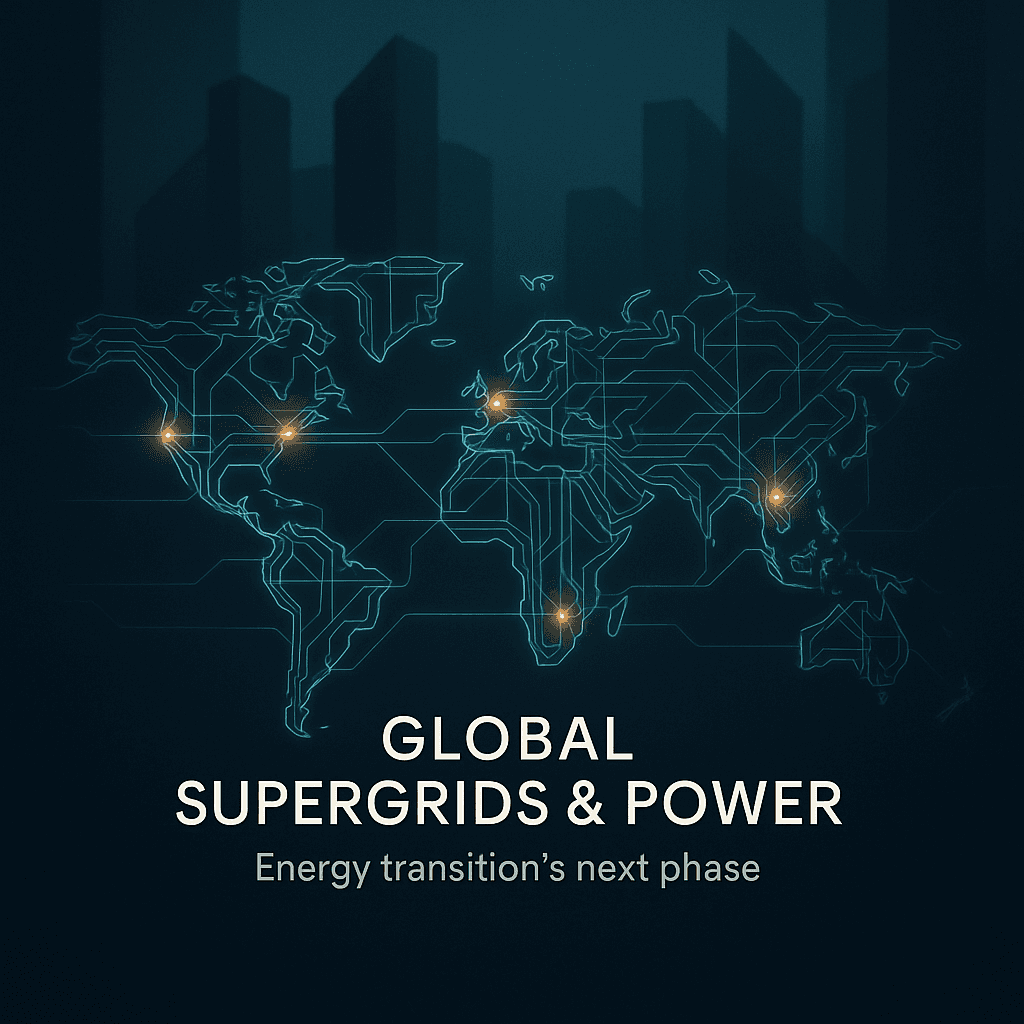
A supergrid, in simple terms, is a higher capacity, longer distance transmission system that moves huge amounts of electricity across regions, smoothing out variability and connecting different resource bases.
Windy places exporting to calm places. Sunny places exporting to cloudy places. Hydropower balancing everything. Batteries and flexible demand filling the gaps. If you zoom out far enough, it starts to look like an internet of power.
And yes, people dream about truly global interconnection.
North Africa to Europe. The Middle East to South Asia. Australia exporting solar. Offshore wind hubs. Arctic routes. Undersea cables that sound like something from a spy novel.
Some of it will happen. Some of it will not. But the direction is clear.
More interconnection. More long distance transmission. More strategic cables and corridors. More power trading that looks like geopolitics.
Which brings us to the second half of the equation.
Why oligarchy fits naturally into supergrids
Supergrids require four things that tend to concentrate power.
- Massive upfront capital, often with long payback periods.
- Political access, because permitting and routing are political.
- Control of critical supply chains, because the physical components have bottlenecks.
- Standard setting, because interoperability is not optional at scale.
Those four things are basically an oligarch’s home turf.
Even in countries with strong institutions, the grid is not a normal market. It is a regulated asset. It is public interest mixed with private capital. It is procurement and concessions and rate cases and development rights.
You do not just “innovate” your way into owning a corridor that crosses three provinces and two national borders.
You finance it. You negotiate it. You secure it. You make it legible to regulators. You make it bankable. You make it inevitable.
That is why transmission historically attracts the same archetypes again and again.
Large utilities. Sovereign wealth funds. Infrastructure funds. Conglomerates. Families with deep networks. People who can sit in a room for two years and still be smiling at the end of it. People who can take a long view because they can survive the short term.
Oligarchy is not only about illegal behavior or corruption. Sometimes it is just concentrated capability.
And supergrids, by design, reward concentrated capability.
The new chokepoints are not oil fields. They are corridors
Old energy power was about owning the resource and the route.
Oil and gas oligarchs, historically, were built on the combination of extraction rights, midstream control, shipping, refining, and political protection. The route mattered almost as much as the well.
In a high electrification world, the “route” becomes transmission.
Not only transmission lines. Also converter stations. HVDC technology. Subsea cable manufacturing capacity. Grid forming inverters. Transformer manufacturing. The software that runs dispatch and markets. The land and sea rights.
And then, quietly, the data layer. Because a supergrid is a cyber-physical system.
A corridor that moves 5 gigawatts from one region to another is not just a piece of infrastructure. It is leverage. It can lower prices, raise prices, stabilize a region, destabilize a region. It can turn stranded renewables into export revenue. It can turn a neighboring country into a balancing resource.
If you control the corridor, you influence all of that.
This is why the next phase of the energy transition is going to produce a different kind of elite, or at least reward the elites who adapt quickly.
Not “drill more.” More like “connect more.”
HVDC is the quiet kingmaker
If you strip away the hype, the enabling technology for supergrids is high voltage direct current, HVDC.
HVDC makes long distance transmission more efficient, especially undersea. It also helps connect asynchronous grids. It gives better controllability, which matters when you are trying to manage variability at scale.
But HVDC has a key feature that makes it politically interesting.
It is modular and strategic.
A few big links can reshape power flows. A single subsea cable can change an island’s economics. A couple of converter stations can turn a remote region into an energy exporter.
That means HVDC projects are high impact, high cost, and relatively few in number compared to smaller distribution upgrades.
And anything that is high impact, high cost, and limited in number tends to become a stage for concentrated capital.
It is not necessarily malicious. It is just how large infrastructure works.
Oligarchic influence does not always look like ownership
When people imagine oligarchs, they imagine direct control. A person owns a company. The company owns the asset. End of story.
But in the grid world, influence can be layered.
You can influence a supergrid without “owning” it in the headline sense.
A few examples of how power shows up:
- Financing power: being the anchor investor that makes a project bankable, and in return shaping terms, routing priorities, or future expansion rights.
- Procurement power: controlling supply chains or being a preferred contractor for converters, cables, transformers.
- Regulatory capture by expertise: being the only group that can reliably execute complex projects, so regulators and politicians end up defaulting to you.
- Market design influence: shaping congestion pricing, cross border trading rules, capacity mechanisms, and interconnection standards.
- Land and permitting leverage: controlling key parcels, ports, or rights of way that make or break a corridor.
- Security framing: positioning a project as critical to national resilience, which can accelerate approvals and limit competition.
If this sounds familiar, it should. It is the same pattern you saw in pipelines, ports, railways, and telecom.
Just with cleaner branding.
The uncomfortable truth. grids create winners, even when electricity is “green”
There is a popular story that renewables democratize energy.
Rooftop solar. Community wind. Local microgrids. Energy independence.
Some of that is real, and some of that is marketing.
At scale, electricity systems still have centralizing tendencies. The bigger and more interconnected the network, the more it rewards actors who can coordinate across jurisdictions and finance complexity.
So you get a split reality.
At the edge of the grid, you may see more local generation and flexibility. People doing smart things with demand response, batteries, EV charging.
But at the core, you may see more concentration.
Because someone has to own, operate, and secure the backbone. Someone has to arbitrate between regions. Someone has to maintain reliability. Someone has to take the risk on long lived assets.
And “someone” tends to be a short list.
This is where the oligarch question becomes practical, not moral.
Do we want the backbone to be dominated by a few private actors. Do we want it to be state owned. Do we want it to be a hybrid. Do we have the institutions to regulate it.
Because if we do not answer those questions deliberately, we will get an answer anyway. The default answer is: concentrated power follows concentrated infrastructure.
Global supergrids turn energy into foreign policy, again
There is another twist.
Cross border interconnection makes electricity trade a foreign policy instrument. It creates mutual dependence, which can be stabilizing. Or weaponizable. Sometimes both, depending on the year.
If a region becomes dependent on imported electricity for winter reliability, that import relationship becomes politically sensitive. If a country becomes an exporter of cheap clean power, it gains leverage. If an interconnector is sabotaged, it becomes a security crisis.
We are used to thinking about these dynamics with gas pipelines. In the next phase, some of that logic migrates to cables and converter stations.
And because these are capital intensive and technically complex, the builders and financiers of cross border links can become geopolitical actors in their own right. Not always openly. Sometimes just through their ability to delay, accelerate, or re route projects.
This is also where the “oligarch” label becomes messy, because the same individual or group can be a private investor, a national champion, and an unofficial diplomat all at once.
The supergrid bargain. speed versus accountability
A lot of governments are staring at the same nightmare.
They need to electrify rapidly. They need to keep prices tolerable. They need to maintain reliability. They need to decarbonize. And they need to do it while voters are increasingly allergic to infrastructure in their backyard.
Supergrids offer a partial escape hatch. Move power around instead of overbuilding everything everywhere.
But supergrids take too long unless someone can force alignment. Which usually means either a strong state, or a coalition of powerful capital and political will.
This is the bargain.
- If you prioritize speed, you may rely more on big players with deep pockets and political reach.
- If you prioritize accountability and competition, projects may slow down, fragment, or die in process.
There is no perfect solution. Only tradeoffs.
And the next phase of the transition will be shaped by how each region chooses to manage that tradeoff.
What to watch. the early signals of oligarchy in the grid era
If you want to see where this is going, do not only watch solar module prices or battery chemistries.
Watch these instead:
1) Who controls HVDC manufacturing capacity
Subsea cable factories, converter technology, transformer production. These are not infinitely expandable overnight. The players who secure long term slots will quietly shape what gets built first.
2) Who gets the first rights on new corridors
Once a route is proven and permitted, expansions become easier. First movers get structural advantage. This is where relationships and capital matter more than cleverness.
3) How grid market rules change
Congestion pricing, interconnector revenue frameworks, capacity markets, curtailment compensation. These rules decide who captures value from the network.
4) Whether supergrids are framed as “security infrastructure”
When projects become national security priorities, procurement and governance can become more closed. Sometimes for good reasons. Sometimes not.
5) The merger wave
Transmission and infrastructure consolidation. Utilities buying developers. Funds rolling up operators. If you see a wave of consolidation, you are watching oligarchic structure form in real time, even if the actors wear suits and publish ESG reports.
A more realistic way to think about “oligarchs” in the transition
In this series, I try to avoid the lazy framing that every oligarch is the same.
The more useful framing is incentives.
If a system rewards concentration, you will get concentrated players. If a system rewards transparency and competition, you will get more distributed outcomes.
Supergrids, by nature, push toward concentration. But that does not mean the outcome is predetermined.
It means governance matters more than ever.
- Clear, enforceable regulation.
- Transparent procurement.
- Open standards.
- Anti monopoly rules that actually apply to grid assets.
- Public participation that does not turn into permanent veto.
- Strong cyber security requirements with real auditing.
- And frankly, competent institutions that can say yes and no without being captured.
Without those, the next phase of the energy transition could decarbonize generation while re concentrating power in a new layer of infrastructure elites.
Clean electrons. Old politics.
Where this all lands
The next phase of the energy transition is going to feel less like a tech boom and more like a civil engineering marathon.
More wires. More steel. More rights of way. More meetings. More lawsuits. More financing.
Supergrids are part of that. Probably a big part. They are not a silver bullet, but they are one of the few realistic ways to scale renewables without drowning in redundancy and instability.
And oligarchy, whether we like the word or not, will be part of that story because concentrated infrastructure invites concentrated power.
The question is not whether powerful actors will show up.
They will.
The question is what kind of rules we build around them. Whether the backbone of a decarbonized world ends up as a public good with fair access, or a toll road with a green label.
That is the real transition hiding under the transition.
And it is already underway.
FAQs (Frequently Asked Questions)
What does the energy transition actually involve beyond just building renewables?
The energy transition is not a single change but multiple overlapping transitions happening simultaneously across power generation, industry, transport, heating, data centers, defense, and the supporting infrastructure like wires, transformers, permitting, land, minerals, and ports. It moves from simply building renewables quickly to managing and integrating the whole system effectively.
Why is the current challenge in energy more about the grid than generation?
While renewable technologies like solar and wind have become cheaper and scaled up rapidly, new challenges have emerged in the electricity network itself—such as long interconnection queues, permitting delays for transmission projects, transformer shortages, grid congestion, and curtailment. These issues reflect a network problem requiring enhanced transmission capacity and coordination rather than just focusing on generation.
What is a supergrid and why is it important for the energy transition?
A supergrid is a high-capacity, long-distance transmission system that connects different regions to move large amounts of electricity efficiently. It smooths variability by linking windy areas to calm ones or sunny places to cloudy ones and integrates diverse resources like hydropower and batteries. Supergrids enable more interconnection, strategic power corridors, and power trading that resembles geopolitics—key to stabilizing grids at regional or global scales.
How does oligarchic power relate to the development of supergrids?
Supergrid development requires massive upfront capital with long payback periods, political access for permitting and routing, control over critical supply chains for components like transformers and cables, and setting interoperability standards. These factors naturally concentrate power among large utilities, sovereign wealth funds, infrastructure conglomerates, and families with deep networks—forming an oligarchic structure that shapes markets quietly through concentrated capability rather than overt corruption.
Why are transmission corridors considered the new chokepoints in a highly electrified world?
In contrast to old energy oligarchies built around owning extraction rights and routes for oil and gas, new chokepoints lie in controlling transmission corridors—including lines, converter stations (like HVDC), subsea cables, transformer manufacturing, dispatch software, land rights, and data layers. Controlling these corridors gives leverage over electricity prices, grid stability across regions or countries, export revenues from stranded renewables, making corridor control a strategic asset in the evolving energy landscape.
What role does HVDC technology play in enabling supergrids?
High Voltage Direct Current (HVDC) technology is crucial for efficient long-distance electricity transmission—especially undersea—and connecting asynchronous grids. Its modularity allows strategic placement of links that can significantly reshape power flows. HVDC also provides better controllability needed to manage variability at scale. This makes it a politically significant ‘kingmaker’ technology underpinning the future of interconnected supergrids.
